
Trending
This story is from February 20, 2011
Expressions of art and soul
There was an abundance of creative energy at the Delhi Art Summit, reports Mona Mehta
There was an abundance of creative energy at the Delhi Art Summit, reports Mona Mehta
Spirituality is like sex -- very personal. I refuse to talk about it openly,” says artist Anjolie Ela Menon. Remind her that she did create Ganeshas in crystal and even painted Christ and she says, “I don’t even want to go there.” Period. But it seems most others don’t have such reservation, going by the plethora of canvases on display that speak the language of the soul, at the recently concluded India Art Summit in Delhi. Some have overtly religious themes while others merely offer a hint of an equation with the eternal!
Apart from maestros like Syed Haider Raza, whose evolved perspective shines through — particularly in his series of paintings on the Bindu and other artworks, there are other artists, too, who have expressed metaphysical and other-worldly themes in their works. Seema Kohli, for instance, whose work was inspired by the Greek mythological character ‘Ouroboros’ — a snake which is shown trying to swallow its own tail — which is a metaphor for the endless cycle of birth and rebirth; also referred to as infinity. “In my work, I use this concept to show that the soul undergoes 84 million births before its final liberation,” says Kohli.
British sculptor Caroline Rothwell displays a PVC installation called Lexicon (Newton’s Tree) that represents the concepts of gravity, evolution and wisdom. “This work refers to physicist Isaac Newton. He excites me because of his varied interests: he broke new ground in Math and Physics, yet, he was also an alchemist and spiritualist. I’m really interested in this non-linear pursuit of meaning,” says Rothwell. Her animal sculptures, say experts, have much in common with the Ouroboros, ‘suggesting cycles that begin anew as soon as they end, an eternal self-consumption’. “I started creating species and worlds that are familiar to us from the past but are changed, and updated for the present,” explains Rothwell.
Adding a touch of black humour to the religious symbolism is Baroda-based artist Balaji Ponna’s work with the following inscription: ‘Because we are so many — gods...we became — street dogs’. Ponna’s creation — wooden stands on which stand fibreglass figures of Rama and Jesus is a comment on human suffering in the name of religion. “In Hyderabad and Vishakhapatnam, I come across many 11 to 13-year-olds dressed up as gods, and they are always asking for money. Through his art, Ponna tries to show that there are people who suffer from the presence of so many gods, just as there are others who take advantage of gods’ names. Then there are those who are sensitive about it; many who fight for it and some who die for it. This is true whether or not they have seen God!
The three-day art summit held in the third week of January was a hub of energy with some 84 galleries exhibiting works by 570-odd artists, both from India and abroad. The exhibition pavilion was bursting with creative energy — and this continued to pulsate through the veins of the 1,28,000 visitors — long after they had left the summit.
Follow us on Twitter for more stories
Spirituality is like sex -- very personal. I refuse to talk about it openly,” says artist Anjolie Ela Menon. Remind her that she did create Ganeshas in crystal and even painted Christ and she says, “I don’t even want to go there.” Period. But it seems most others don’t have such reservation, going by the plethora of canvases on display that speak the language of the soul, at the recently concluded India Art Summit in Delhi.
Apart from maestros like Syed Haider Raza, whose evolved perspective shines through — particularly in his series of paintings on the Bindu and other artworks, there are other artists, too, who have expressed metaphysical and other-worldly themes in their works. Seema Kohli, for instance, whose work was inspired by the Greek mythological character ‘Ouroboros’ — a snake which is shown trying to swallow its own tail — which is a metaphor for the endless cycle of birth and rebirth; also referred to as infinity. “In my work, I use this concept to show that the soul undergoes 84 million births before its final liberation,” says Kohli.
British sculptor Caroline Rothwell displays a PVC installation called Lexicon (Newton’s Tree) that represents the concepts of gravity, evolution and wisdom. “This work refers to physicist Isaac Newton. He excites me because of his varied interests: he broke new ground in Math and Physics, yet, he was also an alchemist and spiritualist. I’m really interested in this non-linear pursuit of meaning,” says Rothwell. Her animal sculptures, say experts, have much in common with the Ouroboros, ‘suggesting cycles that begin anew as soon as they end, an eternal self-consumption’. “I started creating species and worlds that are familiar to us from the past but are changed, and updated for the present,” explains Rothwell.
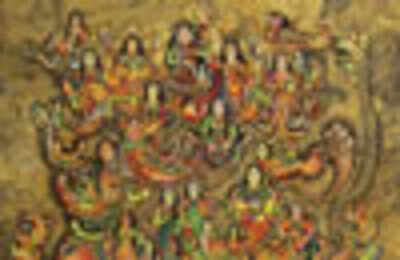
Adding to the spiritual quotient of the show was Jayasri Burman’s work titled Dharitri, depicting the divine feminine in ink and oil on canvas. Done in her trademark folk art style, Dharitri shows the web of life in which feminine energy takes various forms — now as mother, now as a little girl, holding the universe together.
Adding a touch of black humour to the religious symbolism is Baroda-based artist Balaji Ponna’s work with the following inscription: ‘Because we are so many — gods...we became — street dogs’. Ponna’s creation — wooden stands on which stand fibreglass figures of Rama and Jesus is a comment on human suffering in the name of religion. “In Hyderabad and Vishakhapatnam, I come across many 11 to 13-year-olds dressed up as gods, and they are always asking for money. Through his art, Ponna tries to show that there are people who suffer from the presence of so many gods, just as there are others who take advantage of gods’ names. Then there are those who are sensitive about it; many who fight for it and some who die for it. This is true whether or not they have seen God!
The three-day art summit held in the third week of January was a hub of energy with some 84 galleries exhibiting works by 570-odd artists, both from India and abroad. The exhibition pavilion was bursting with creative energy — and this continued to pulsate through the veins of the 1,28,000 visitors — long after they had left the summit.
Follow us on Twitter for more stories
End of Article
FOLLOW US ON SOCIAL MEDIA
Visual Stories






lifestyle videos

Featured In Lifestyle
Popular Categories
Entertainment NewsBollywood NewsTollywood NewsKollywood NewsMollywood NewsMovie ReviewsLatest Hindi MoviesLatest Tamil MoviesMX PlayerParenting TipsHome RemediesWeight LossBeauty TipsParenting TipsHindi VideosHindi Video SongsBhojpuri Music VideosLatest Telugu MoviesBhojpuri Music VideoHindi TV News
Trending in Entertainment
Latest MoviesBollywood MoviesHollywood MoviesTamil Movies 2024Telugu Movies 2024Malayalam Movies 2024Kannada Movies 2024Marathi Movies 2024Bengali Movies 2024Top Rated Movies 2024Best Hindi MoviesBest English MoviesBest Telugu MoviesBest Tamil MoviesBest Malayalam MoviesBest Kannada MoviesBest Bengali MoviesUpcoming Hindi MoviesBest Movies Of All TimeBest Hindi Movies of All Time
Trending in Etimes
Horoscope TodayNumerology Predictions TodayProject 2025Taylor SwiftUS Presidential Debate Key TakeawaysSpringfield Eating PetsMelania TrumpJoe WilsonVice Presidential DebateMeghan MarkleKamala HarrisDonald TrumpPatriot Day 2024Diabetes RiskAbrosexualityTrump Vs HarrisJoe JonasNational Day of Encouragement 2024Dave Bautista
Trending in TV
Trending in Lifestyle
Trending in Regional
Movie Reviews
Visfot ReviewThalapathy Is The G.O.A.T ReviewRebel Ridge ReviewDetective Conan vs. Kid the Phantom Thief ReviewBeetlejuice Beetlejuice ReviewPad Gaye Pange ReviewA Wedding Story ReviewThe Diary Of West Bengal ReviewTikdam ReviewKinds Of Kindness ReviewAfraid ReviewThe Deliverance ReviewBlue Lock: Episode Nagi ReviewDaddio Review
Upcoming Hindi Movies
Latest News
Manju Warrier expresses gratitude for birthday wishes: "Forever humbled and grateful"Haryana HPSC PGT admit card 2024 out at hpsc.gov.in: Direct link to download hall ticket here6,0,6,6,6 - Smashing Kieron Pollard rolls back the clock in Caribbean Premier League - WatchJiiva and wife escape with minor injuries after a road accidentWhy can Banyan trees survive for centuries and spread indefinitely?Relief for Amul in trademark war against Italian brandAfghanistan vs New Zealand: Why is Greater Noida stadium hosting a Test match?Shilpa Shetty and Raj Kundra spotted at the Siddhivinayak Temple; video insideNBA 2K25 locker codes September 2024: Locker codes revealed and know how to reveal themDonald Trump and Kamala Harris shake hands as they meet for first time on debate stage: Watch the 'awkward' momentPrince William’s commitment to a lasting marriage with KateWhen Jaya Bachchan revealed she had a huge crush on Dharmendra, called him a 'Greek God' in front of Hema MaliniJr NTR starrer 'Devara: Part 1' completes censorship formalities; receives UA certificateGeorgia school shooting: Suspect's mom's call wasn't the only alert, multiple warnings overlooked before Apalachee high attack'Trump should not be telling a woman what to do with her body', says Kamala Harris on abortion rights during US presidential debateArbaaz Khan spotted outside Malaika Arora's house along with police after the tragic news of her father's demise by alleged suicide - WATCH VIDEOShivaji statue collapse: Sculptor’s custody extended till September 13Vijay Sethupathi and Trisha starrer '96' to have a sequel, reveals Prem Kumar
Copyright © 2024 Bennett, Coleman & Co. Ltd. All rights reserved. For reprint rights: Times Syndication Service